Our Location
304 North Cardinal St.
Dorchester Center, MA 02124

304 North Cardinal St.
Dorchester Center, MA 02124


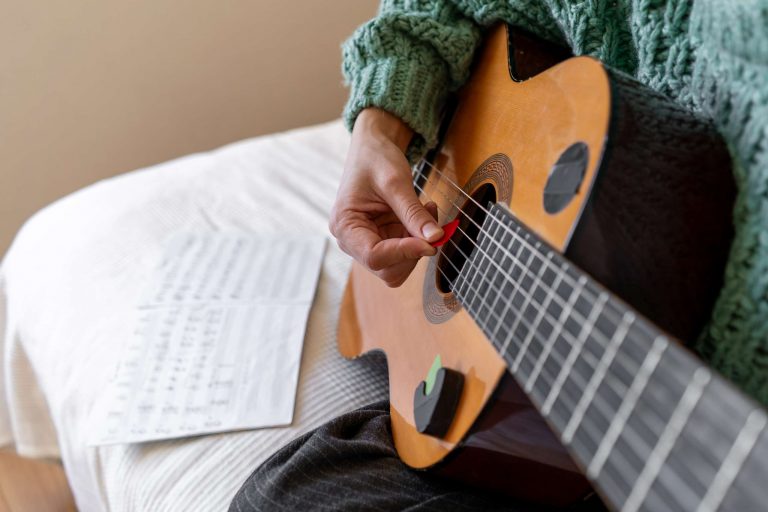
One of the best things about practicing guitar on a regular basis is the way your skills begin to translate into musical expression over time. When you first start out, you are going to be very focused on the physical and technical side of playing. You will spend most of your time trying to improve your techniques, and this is completely natural. However, as you continue to practice regularly and consistently, you will eventually get to a point where your technical playing skills become second nature to you.
Everyone starts out very enthusiastic about learning guitar, but the truth is, it’s not about motivation. In fact, most people believe that if you really want to see improvement, you have to practice for hours on end every day. When in reality, the best results come from short practice sessions, where your focus should be on repeated exercises. The more you repeat them, the more accurate your left and right hand coordination will be. Your sense of rhythm will become more precise, and your ability to achieve a clear, resonant sound will be developed. Eventually, everything will start to feel effortless, and the guitar will start to sound the way you want it to.
However, regularity also affects the brain’s relationship with music. If we practice daily or almost daily, the pathways in our brain associated with chord changes or rhythmic sequences build upon each other, growing stronger each day. If we allow days or weeks to pass between sessions, we’re forced to recreate from scratch skills that are still rusty from disuse. It’s demotivating and gives the illusion of plateauing when in fact we are simply experiencing stop and go. With consistent practice, even small amounts, we can continue from where we left off at the last practice session.
Yet another crucial advantage of regular practice is refinement of the ear. During the initial phases, most of the practice is geared towards fingering and memorization and there isn’t much time for developing your listening skills. As the movements become internalized, you can start paying more attention to the sound, dynamics, and phrasing. At this point, a fundamental change occurs in the practice routine. The guitarist starts not just playing the right notes, but is also starting to ‘create sound’. The slight alterations in pressure, the almost imperceptible differences in timing, the slight change in articulation, have become expressive.
Consistency leads to confidence too. The more frequently you play, the more likely you are to try new things, either new techniques or styles of music. Every successful day will make you feel like you’re able to do it again, and this is important, as there will be days where you don’t make progress. Music is a series of breakthroughs and plateaus, and if you rely only on the breakthroughs for motivation, you will quit.
After a while, with practice, the guitar ceases to be something separate from the individual and becomes an internal medium of expression. The fingers no longer need to be told what to do. The mind is then free to engage in musical ideas. The “exercise” becomes a conversation with the guitar, the expression of the inner life of the individual. This does not happen quickly. With time and practice, even modest daily practice, the person develops skill and the ability to express themselves.