Our Location
304 North Cardinal St.
Dorchester Center, MA 02124

304 North Cardinal St.
Dorchester Center, MA 02124

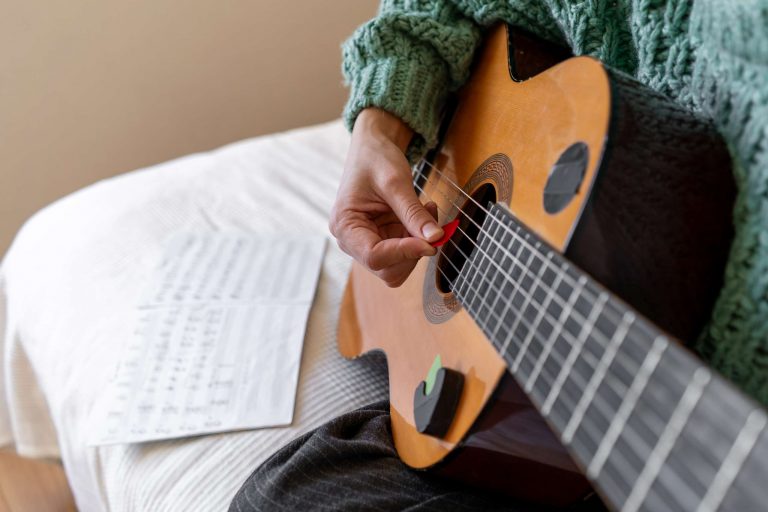
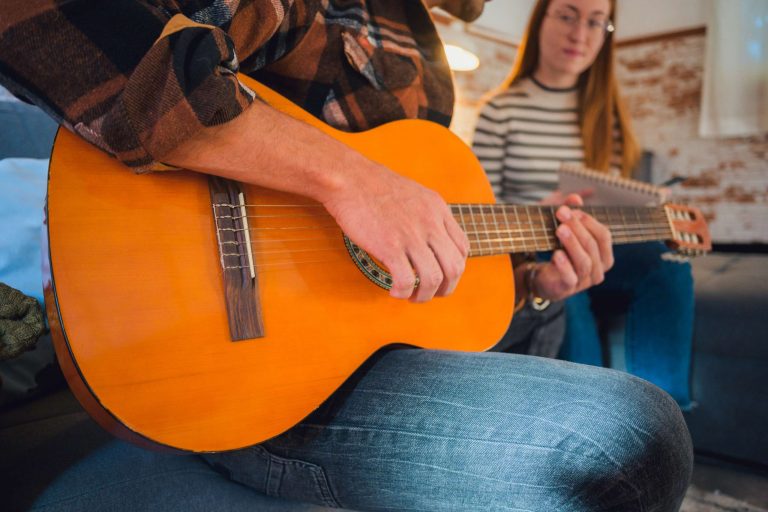
Most people start out by practicing shapes and chords, maybe even a simple strumming pattern or two. This lets you play songs fast and gets you excited, which is important. But it also gets your fingers stronger, gets your hands working together and helps you learn the fretboard. You learn where chords are on the neck and how to switch between them. It might seem robotic at times but it’s a necessary precursor. You need it to play anything else.
Once a certain level of technical proficiency has been attained, it is common for students to feel confined to playing other people’s music. The desire arises to compose their own music or at least to personalize the music of others. This is an overwhelming experience for those who have not been exposed to traditional notation or formal music theory. The student starts to wonder how chords are constructed, why chord progressions sound good, and how musicians achieve their distinctive sound. It is at this stage that the student discovers that technical facility does not imply musical artistry. To develop a unique musical voice, there must be experimentation, inquiry, and a departure from rigid guidelines.
A good starting point is to experiment with chord voicings. Don’t always play full, open chords – sometimes take a note away or add an extra one. This can completely alter the mood of a chord: for example, if you leave out the third it becomes suspended and uncertain, or if you replace it with a suspended note it will sound more tense and open. Try shifting chord shapes around the fretboard, use a capo in an interesting way, or play only a few strings. This will give you a broader range of tonal options and you may find some you particularly like.
Just as crucial is how you physically play it. Using a pick is just one technique. You can fingerpick, and have separate parts for your thumb and fingers. You can use hybrid picking to get a blend of clarity and tone. You can use palm muting to get a more staccato sound. You can change attack, dynamics and timing to make the same chord progression sound emotive. You can try different amp settings, different effects or different acoustic properties. The point is: tone is not just a matter of what you play, but how you play it.
This is something that takes place over months and years rather than days. You will be influenced by guitarists you like; in fact, that’s a good thing. You can pick up useful licks and techniques by listening to their playing. But the end result should be fusion, and not copying: taking bits from different players and mixing them with your own tastes and interests. The more you play, the more you listen, and the more you experiment, the more your own style will take shape. Eventually you will notice that you tend to favour particular grooves, chord progressions and tones. With time and effort, the guitar is a tool that you can use to say something that is truly yours.